I bet that peace is not the first word that comes to your mind when you think about the Roman Empire.
Rightly so, as the Romans were known for waging ruthless wars that allowed their tiny city-state on the Apennine Peninsula to conquer the entire Mediterranean basin. Organisational and technological innovations turned Roman legions into a formidable military force that was unmatched in the ancient world. Military prowess was high on the list of civic virtues in a society that produced many strategic geniuses such as Julius Caesar, Scipio Africanus and Marcus Agrippa. In this post, however, I would like to look at Roman history from a different perspective.
The reign of Augustus, who founded the Roman Empire in 27 BC, is often seen as the beginning of a 200-year-long golden age, known in Latin as Pax Romana (“Roman Peace”). This was a period of Rome’s undisputed hegemony in the Mediterranean area and was characterised by relative peace, stability and prosperity. Although civil strife and wars with neighbouring powers, such as at the Parthian Empire in present-day Iran, occasionally broke out throughout this era, we should understand Pax Romana in the context of incessant conflicts that plagued the preceding and subsequent periods of Roman history.
According to a Roman tradition going back to the 7th century BC, the doors of the temple of the double-faced god Janus remained open during wartime, but were closed in times of peace. Whereas the Gates of Janus had previously been closed only twice, Emperor Augustus achieved the remarkable feat of closing them three times during his reign.
Altar of Peace
The third closing of the Gates of Janus by Augustus probably occurred in 13 BC and coincided with the commissioning of an outstanding monument dedicated to peace. The Ara Pacis Augustae (“Altar of Augustan Peace”) is a large marble structure decorated with intricate relief sculptures. Many of the carved panels represent mythological figures and scenes symbolising peace and prosperity.
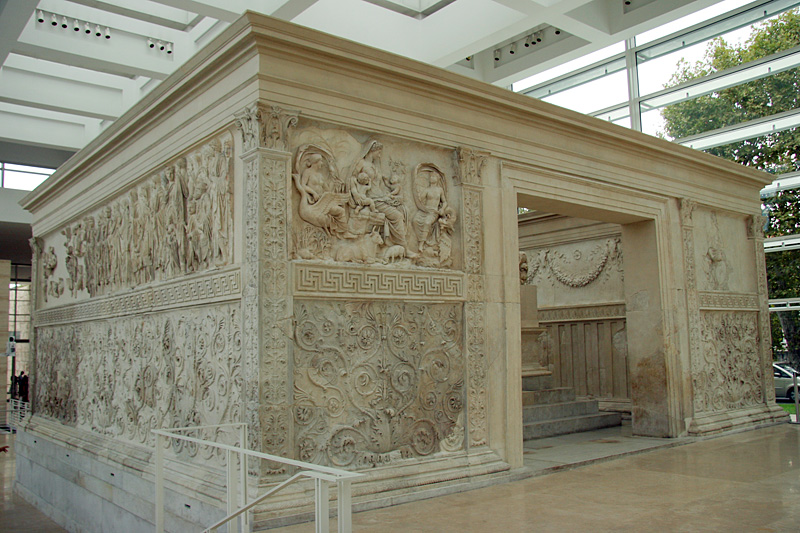
Source: Quinok, 10.09.2010, available under licence CC BY-SA 3.0
The original structure was flooded by the Tiber River after the fall of the Roman Empire, but some of its fragments were discovered during the Renaissance and ended up in various museum collections in Rome, Florence and the Louvre. The Fascist regime excavated the rest of the altar in the late 1930s and reconstructed it near the restored Mausoleum of Augustus. A new museum building, constructed to house the altar, was opened in 2006.
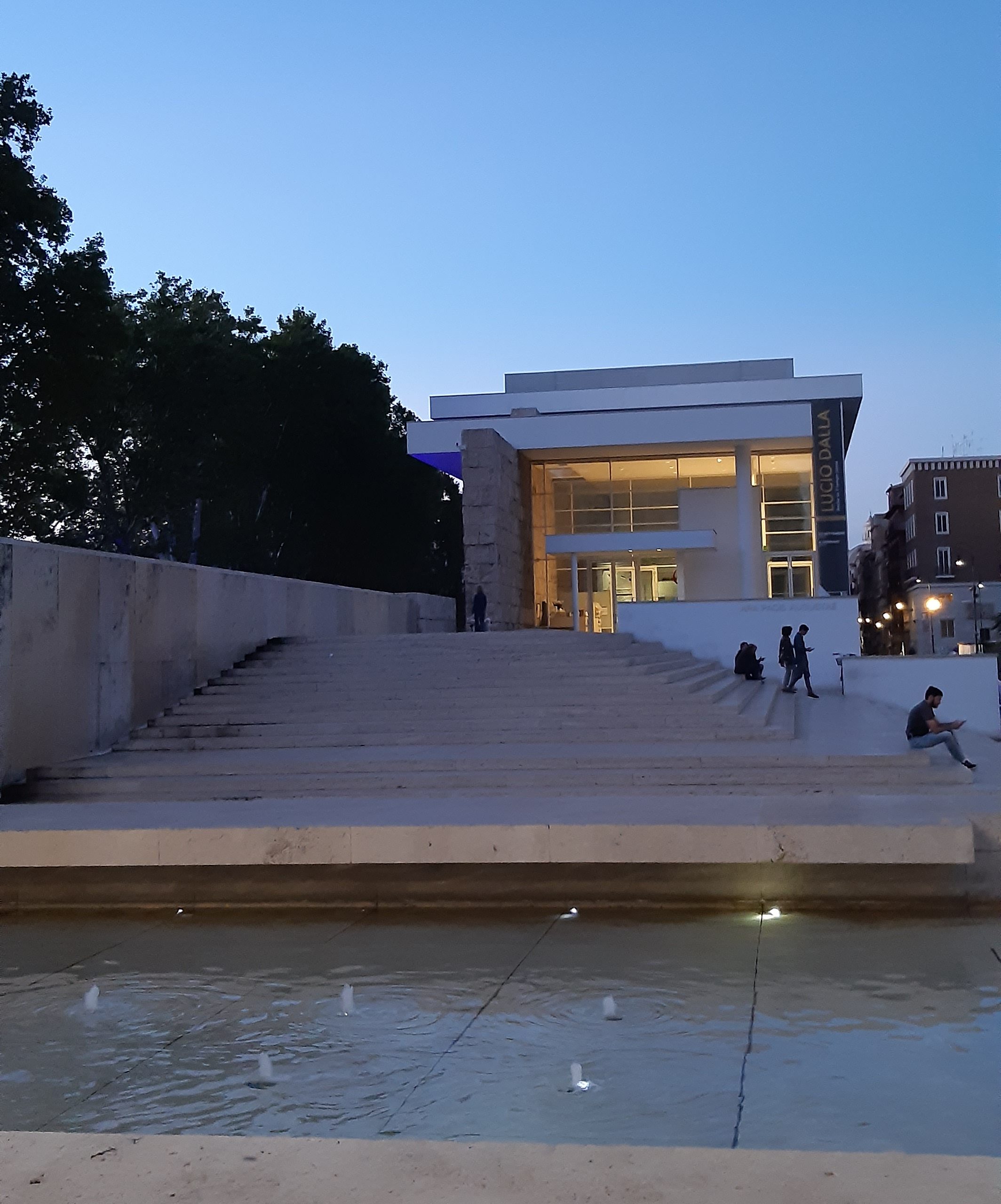
Source: My own photo, 21.09.2022
The altar was originally built by Augustus as a propaganda tool of his new imperial regime and was later appropriated by Mussolini as a symbol of national glory. For me, however, the Ara Pacis is a powerful reminder that the pursuit of peace was an important, if elusive, ideal of the ancient Roman society.
Perhaps this desire for peace explains why the new Christian religion gained so much popularity in the Roman Empire? After all, the “Prince of Peace” was one of the Messianic titles attributed to Jesus Christ, who – in accordance with the Gospel of Luke – was born in Judea during the reign of Emperor Augustus. Although the Catholic Church would later adopt the “just war” theory, which soon degenerated into the folly of Crusades and wars of religion, early Christianity was a radically non-violent religion. Thankfully, the pontificate of Pope Francis has marked a decisive return to this earlier pacifist tradition.
Dying Gaul
The Biblical story of the passion of Christ testifies that the Romans could be extremely brutal when it came to dealing with their enemies. The crucifixion was actually their favourite method of executing captured rebels. After suppressing the Spartacus revolt in 71 BC, Roman legions crucified 6,000 rebelled slaves along Via Appia, the ancient road from Rome to Capua. Yet, the idea of honouring a defeated enemy was not completely alien to the Romans.
The Capitoline Museums in Rome house one of my favourite sculptures, the Dying Gaul, a marble copy of a lost Hellenistic bronze statue from the 3rd century BC. This masterpiece represents a mortally wounded Celtic warrior wearing a characteristic necklace known as the torque. The Romans frequently fought against the Gauls (a group of Celtic tribes that lived in Western Europe) from the early 4th century BC until Julius Caesar’s conquest of Gaul in 50 BC. The Gauls were renowned as fierce warriors and, according to ancient sources, they sometimes went into battle completely naked except for their torques!
I wanted to see the Dying Gaul ever since I read about it in a book about ancient Celts, which my parents got me when I was still in primary school in the late 1990s. Thanks to my resourceful wife, I was finally able to fulfil this childhood dream during our honeymoon trip to Rome in September 2022. The dignified pose of the dying warrior symbolises for me the recognition of common humanity in a defeated enemy.
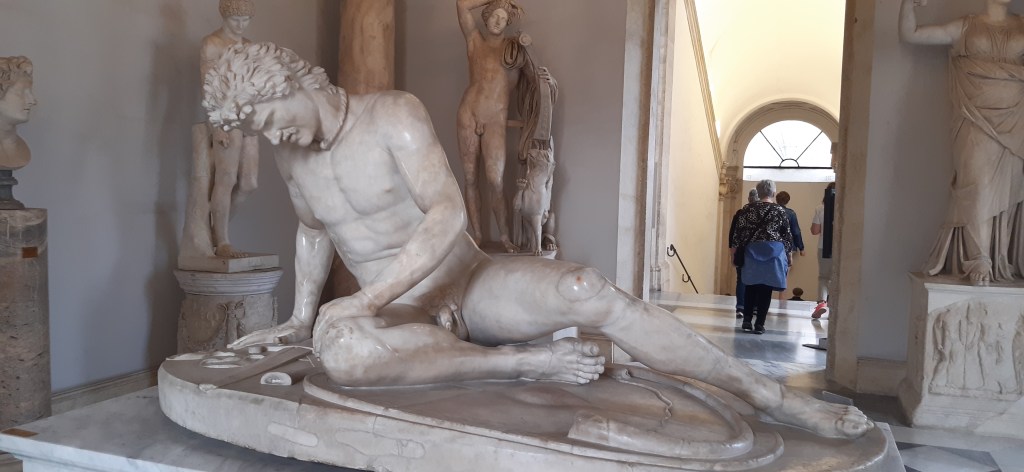
Source: My own photo, 25.09.2022
Following its rediscovery in the 17th century, this sculpture remained one of the most celebrated works of ancient art, but it gained a new meaning in the aftermath of the bloodshed of the First World War. On 19 December 1922, the Norwegian diplomat Fridtjof Nansen, whom you might remember from one of my earlier posts, opened his Nobel Peace Prize lecture with a reflection on the Dying Gaul:
In the Capitoline Museum in Rome is a sculpture in marble which, in its simple pathos, seems to me to be a most beautiful creation. It is the statue of the “Dying Gaul”. He is lying on the battlefield, mortally wounded. The vigorous body, hardened by work and combat, is sinking into death. The head, with its coarse hair, is bowed, the strong neck bends, the rough powerful workman’s hand, till recently wielding the sword, now presses against the ground in a last effort to hold up the drooping body.
He was driven to fight for foreign gods whom he did not know, far from his own country. And thus he met his fate. Now he lies there, dying in silence. The noise of the fray no longer reaches his ear. His dimmed eyes are turned inward, perhaps on a final vision of his childhood home where life was simple and happy, of his birthplace deep in the forests of Gaul.
That is how I see mankind in its suffering; that is how I see the suffering people of Europe, bleeding to death on deserted battlefields after conflicts which to a great extent were not their own.
Tragically, these words still resonate today with thousands of soldiers dying on the battlefields of Ukraine, the Middle East, Sudan and elsewhere. With wartime propaganda constantly trying to dehumanise the other side’s combatants, who are not killed but “eliminated” or “neutralised”, the 2,000-year-old sculpture of the Dying Gaul reminds us to treat even our enemies with respect, especially in death.
War and peace with ancient Iran
The Romans knew the value of diplomacy. I would therefore like to end this post by recounting a little known episode from the 1st century BC. In encounter with the Parthian Empire, a rival power from ancient Iran, the Romans learned the hard way to choose negotiated peace over victory on the battlefield. In 53 BC, the Romans suffered one of the worst defeats in their history at the battle of Carrhae (near present-day Harran in southeastern Turkey). Seven legions under the command of Marcus Licinius Crassus – a two-time consul who had previously crushed the Spartacus rebellion – were ambushed and destroyed by the highly mobile Parthian cavalry. The outnumbered and underestimated Parthians killed 20,000 Romans, including Crassus and his generals, and captured several Legionary Eagles. Roman troops revered these standards with almost religious zeal and saw losing them as extremely shameful and dishonourable.
Both Julius Caesar and Mark Antony tried to avenge the humiliation of Carrhae and recover the lost Legionary Eagles. Caesar’s planned campaign against the Parthians was cancelled after his assassination on the Ides of March in 44 BC, just three days before his intended departure from Rome. In turn, Antony’s much-vaunted invasion of the Parthian Empire in 36 BC turned into a failure, despite the help he received from Egypt’s queen Cleopatra. After defeating the armies of Antony and Cleopatra in the last civil war of the Roman Republic, the new emperor Augustus marched himself against the Parthians in 20 BC. Yet, instead of another bloody confrontation on the battlefield, the campaign ended with a peace treaty. The Parthians agreed to return all the Legionary Eagles they had captured 33 years earlier at Carrhae and the Romans pulled out without a fight. In this way both sides saved face and could claim victory. The treaty delineated spheres of influence on both sides of the Euphrates River and secured peace between the two great powers that lasted for almost 80 years.
Do you think there is a lesson current world leaders could learn from this episode?

