Pope Francis who passed away on Easter Monday was my personal hero and it was his teaching that convinced me to embrace pacifism. In September 2022 – thanks to my amazing wife! – I had the honor of meeting him at St Peter’s Square in Rome. This blog post is a tribute to his legacy as a hero of peace.
Peacemaking was at the core of the late Pope’s 12-year-long pontificate. Unfortunately, his words and gestures were often misunderstood and criticized by secular media. Even inside the Catholic Church, many faithful have struggled with his counter-cultural teaching on peace. That is why I like to call Pope Francis a prophet of peace. A prophet is someone who tells uncomfortable truths to the people, especially those in power, and warns them about the grave consequences of ignoring the signs of the times. Prophets are rarely listened to in their lifetime but are usually proven right by future events. In this post I would therefore like to remind you about some “prophetic” words and gestures of Pope Francis.
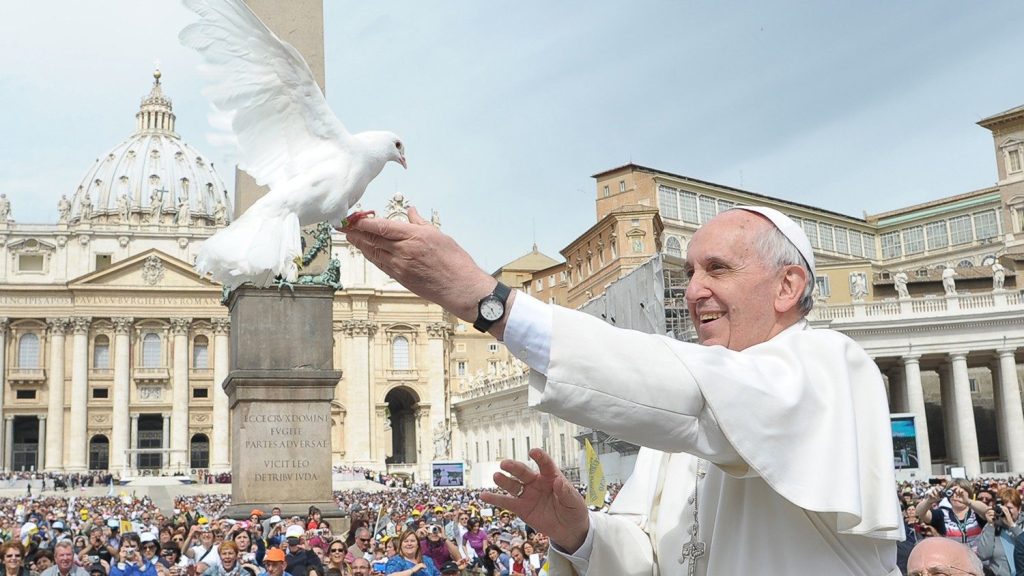
Source: https://www.vaticannews.va/en/pope/news/2025-04/pope-francis-death-peace-legacy-appeals.html
Never again war!
In his encyclical letter “Fratelli tutti”, published in 2020, Pope Francis rejected the doctrine of “just war”. This was a traditional Catholic teaching that was first formulated by St Augustine of Hippo in the early 5th century. The doctrine of “just war” stipulated rigorous conditions under which the use of military force can be morally legitimate. One of these essential conditions was to avoid casualties among non-combatants. In light of the destructive capabilities of modern weapons, Pope Francis has argued that waging “just war” is no longer possible in our age:
We can no longer think of war as a solution, because its risks will probably always be greater than its supposed benefits. In view of this, it is very difficult nowadays to invoke the rational criteria elaborated in earlier centuries to speak of the possibility of a “just war”. Never again war! (“Fratelli tutti“, 258)
The Pope’s categorical rejection of an age-old doctrine has been difficult to accept by many Catholics. George Weigel, a prominent American conservative intellectual and biographer of John Paul II, went as far as calling the claim that there is no such thing as just war a “dangerous nonsense”. Even more liberal Catholic theologians were confused by this new teaching and came up with some hair-splitting exegeses of the Pope’s words in order to salvage the just war doctrine.
Courage of the white flag
True to his words, Pope Francis responded to the Russian invasion of Ukraine in February 2022 with diplomatic efforts to end the conflict. Unlike most European politicians who quickly fell into a frenzy of Cold War-style militarism and pushed for a Ukrainian victory on the battlefield, the Pope rejected the logic of military force and consequently called for an end to the bloodshed in “martyred Ukraine”. His criticism of NATO expansion and refusal to become “the chaplain of the West”, drew the ire of many supporters of Ukraine. The Pope’s peace-making efforts were ridiculed as naive at best and he was repeatedly criticized in Western media for not condemning Russia as the aggressor. But it was his words from March 2024 about the “courage of the white flag” that caused the most backlash. Misunderstood as a call for Ukraine to surrender to Russia, the contentious phrase was used in an interview the Pope gave to a Swiss TV channel. It is therefore worth quoting the relevant passage in full:
In the interview, the interviewer Lorenzo Buccella asks the Pope: “In Ukraine, some call for the courage of surrender, of the white flag. But others say that this would legitimize the stronger party. What do you think?”
Pope Francis replied: “That is one interpretation. But I believe that the stronger one is the one who sees the situation, who thinks of the people, who has the courage of the white flag, to negotiate. And today, negotiations are possible with the help of international powers. The word ‘negotiate’ is a couragous word. When you see that you are defeated, that things are not going well, it is necessary to have the courage to negotiate. You may feel ashamed, but with how many deaths will it end? Negotiate in time; look for some country that can mediate. Today, for example in the war in Ukraine, there are many who want to mediate. Turkey has offered itself for this. And others. Do not be ashamed to negotiate before things get worse.”
In another, lesser-known statement on the war in Ukraine, Pope Francis said:
“What kind of victory will it be to plant a flag on a pile of rubble?”
Any talk of negotiating with the aggressor was long taboo in the West, but a US-brokered peace deal between Ukraine and Russia is currently on the table. Although Pope Francis will not live to see the end of the war in Ukraine, his funeral last Saturday became an unexpected opportunity for an informal meeting between US President Donald Trump and Ukrainian President Volodymyr Zelenskyy. Commenting on this “very symbolic meeting” in a social media post, Zelenskyy expressed hopes that the encounter will lead to a “full and unconditional ceasefire” as well as a “reliable and lasting peace that will prevent another war from breaking out”.
Kissing the feet of South Sudanese leaders
Despite all the controversies surrounding his attitude towards the war in Ukraine, no action of Pope Francis was more shocking than his dramatic gesture of kissing the feet of South Sudanese leaders. The overwhelmingly Christian country of South Sudan became an independent state in 2011 but soon descended into a bloody civil war between the supporters of President Salva Kiir and the rebels led by Riek Machar. The warring factions eventually signed a deal in 2018 but the power-sharing agreement was not fully implemented and peace remained fragile. The rival leaders came to the Vatican City for a spiritual retreat in April 2019 and it was at the end of this event that Pope Francis unexpectedly went on his knees and kissed the feet of five South Sudanese politicians, begging them to continue with the peace process in their country.
Four years later, the Pope came to South Sudan with an ecumenical peace mission, accompanied by the leaders of the Church of England and the Church of Scotland. Addressing the rival leaders Salva Kiir and Riek Machar, the Pope urged them to implement the stalling peace process and warned that:
Future generations will either venerate your names or cancel their memory, based on what you now do. For just as the Nile leaves its sources to begin its course, so the course of history will leave behind the enemies of peace and bring renown to those who are true peacemakers.
Tragically, recent violence has threatened to rekindle civil war in South Sudan.
Just as the warnings of other prophets, whether Cassandra in Greek mythology or Jeremiah in the Hebrew Bible, were ignored and ridiculed by their contemporaries, so the words and gestures of Pope Francis were often too uncomfortable for us to accept.
Do you think history will prove him right?
 History of Peace