If you ever travel to the beautiful city of Edinburgh, don’t forget to visit the Old Medical School in Teviot Place. When you enter the main quadrangle of this impressive building, turn around and look at the big bronze plaque on the right side of the portal. You will see the following inscription:
In the dark days of 1941 when Polish universities were destroyed and Polish professors died in concentration camps the University of Edinburgh established the Polish School of Medicine. This memorial was set up by the students, lecturers and professors of the Polish School of Medicine in gratitude to the University of Edinburgh for the part it played in the preservation of Polish science and learning.
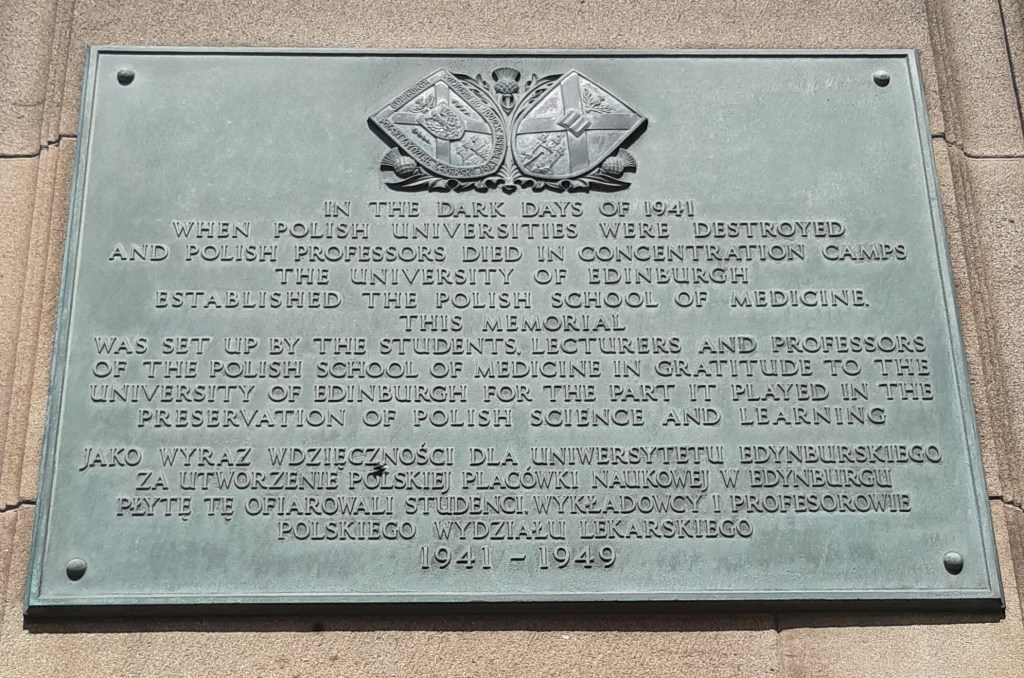
This memorial tablet evokes an extraordinary episode of people-to-people friendship in times of war. It all began in September 1939 when Poland was invaded, conquered and partitioned by Nazi Germany and the Soviet Union. The invaders proceeded to destroy academic life in the occupied country by closing down Polish universities and executing leading intellectuals. Hans Frank, Governor-General of German-occupied Poland, openly admitted that his aim was to turn Poland into “an intellectual desert”. Little could he know that Polish science and learning would soon be resurrected within the walls of the famous University of Edinburgh!
A Polish army was meanwhile reorganised in exile by refugees who managed to escape from occupied Poland. After the capitulation of France in the summer of 1940, thousands of Polish soldiers and civilian refugees were evacuated to Britain. Polish troops who were deployed to protect the east coast of Scotland from an expected German invasion incidentally had a surplus of medical officers, among them many university professors and lecturers as well as students from pre-war Polish medical schools. This unusual occurrence was noticed by Lieutenant-Colonel Francis Crew, Commanding Officer of the Military Hospital at Edinburgh Castle and a peace-time Professor of Animal Genetics at the University of Edinburgh. Professor Crew, who was fully aware of the plight of universities in occupied Poland, put forward the idea of opening a Polish-language medical faculty within the University of Edinburgh in order to allow the Polish refugees to resume medical studies that were interrupted by the invasion of their homeland. The university authorities in Edinburgh endorsed Crew’s proposal, even though Sir Sidney Smith, Dean of the Faculty of Medicine, retrospectively noted that:
with the country facing the possibility of invasion and the University the probability of destruction by bombing, the time would not seem propitious for a unique adventure in academic policy.
It should not then come as a great surprise that Edinburgh’s “magnanimous gesture in wartime” was accepted by the Poles with heartfelt joy and gratitude. Dr Wiktor Tomaszewski, one of the wartime refugees who had been drafted into the Polish army in Scotland, recounted how:
one day in November [1940] someone brought the news that a Polish medical faculty was to be organised in Scotland. It seemed so incredible, so fantastic, so utterly unreal, that we simply dismissed it as one of the wild rumours that from time to time swept through the military camps. But soon it was confirmed that negotiations were underway between the University of Edinburgh and Lieutenant-Colonel Professor Jurasz from Poznań, representing the Polish Government in London. The medical students in our unit were overwhelmed with joy and hope, and so were we, the few senior lecturers from the pre-war Polish medical faculties, who in these circumstances were destined to be members of the teaching staff
The Polish School of Medicine was officially established on 24 February 1941 by an agreement between the University of Edinburgh and the Polish government-in-exile in London. In fact, at the time of its creation, the Polish School of Medicine in Edinburgh was the only officially existing Polish institution of higher education in the world!

The opening of an entirely autonomous Polish faculty within the organisational structure of a Scottish university was an unprecedented experiment in transnational academic cooperation. Polish professors were teaching Polish students in their native language, using the facilities provided by their Scottish colleagues. Twelve professors of the University of Edinburgh volunteered to hold those chairs in the Polish school which could not be filled by appropriate Polish specialists. Some of them even gave lectures to Polish students and conducted examinations, usually with the help of interpreters. Scottish research assistants, lab technicians and janitors worked for Polish departments, while Polish medical scientists contributed to research conducted in Scottish laboratories. Between 1941 and 1949 more than 300 wartime refugees from Poland (men and women, Jews and Christians) attended the Polish School of Medicine in Edinburgh, where they learnt how to heal bodies and save lives.
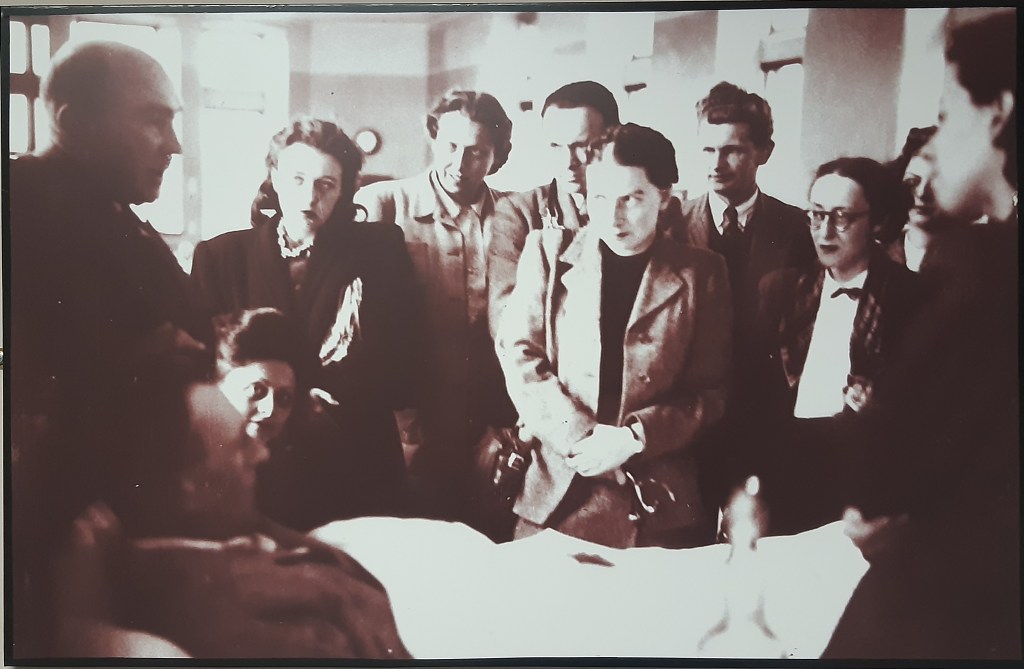
(first from the left: Dr Wiktor Tomaszewski)
Unfortunately, the majority of Polish medical refugees were not able to return home after the end of the war. Poland was liberated from Nazi terror, only to fall under Soviet domination for the next 45 years. Instead of going back to Communist-controlled Poland, some of the former students and members of the staff decided to permanently settle down in Scotland. Dr Wiktor Tomaszewski, for example, became a much respected GP in Edinburgh. Other refugees moved south to England, emigrated to North America, Australia and New Zealand or joined the medical service in British colonies in Africa and Asia. The knowledge, skills and qualifications gained during their wartime studies in Edinburgh allowed them to pursue successful professional careers, regardless of where they eventually settled down.
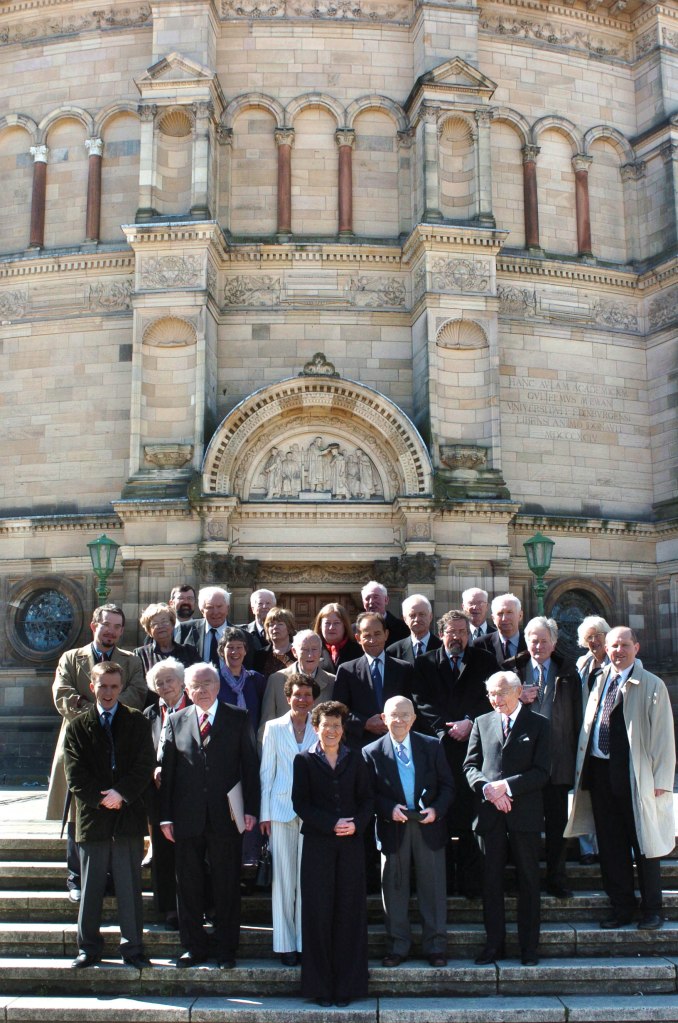
Although they have dispersed all around the globe, the graduates of the Polis School of Medicine have been gathering in Edinburgh every five years since 1966 to demonstrate their loyalty and affection for the University and the town where they found hospitality and friendship at the darkest hour of modern Polish history. Lord Swann, former Principal and Vice-Chancellor of the University of Edinburgh, observed in 1983 that:
No one of who knows Edinburgh can fail to be struck by the gratitude that the members of the Polish School of Medicine have always shown to the University. But I believe that a greater debt of gratitude is owed by the University to them. For it was they who came here to continue the struggle alongside us. And in all its 400 years the University cannot, I think, have acquired a group of alumni more splendidly loyal to their Alma Mater
In May 2011, the last surviving graduates gathered once again to celebrate the 70th anniversary of the founding of the Polish School of Medicine. This occasion was marked by the opening of a special exhibition in the Edinburgh University Library Gallery. A permanent exhibition of the Polish School of Medicine Historical Collection can now be viewed in the Chancellor’s Building in the suburb of Little France.
The existence of the Polish School of Medicine in Edinburgh was relatively short, but the legacy of Scottish-Polish academic cooperation still continues to inspire scientific and cultural contacts between the two nations. The Polish School of Medicine Memorial Fund was set up by the graduates and friends of the School in 1986. The Fund supports academic exchange and collaboration between the University of Edinburgh and medical schools in Poland. The historical significance of this episode was probably best summed up by Professor Jakub Rostowski, the last Dean of the Polish School of Medicine, in a commemorative article written for the British Medical Journal in 1966:
The creation of the Polish School of Medicine within the University of Edinburgh was a fine example of cooperation between nations in the academic sphere. It is to be hoped that such cooperation will not remain unique in the history of medicine, even though one must also hope that the need which gave rise to it will never be experienced again.
Can you think of other stories like this that should also be told?
 History of Peace