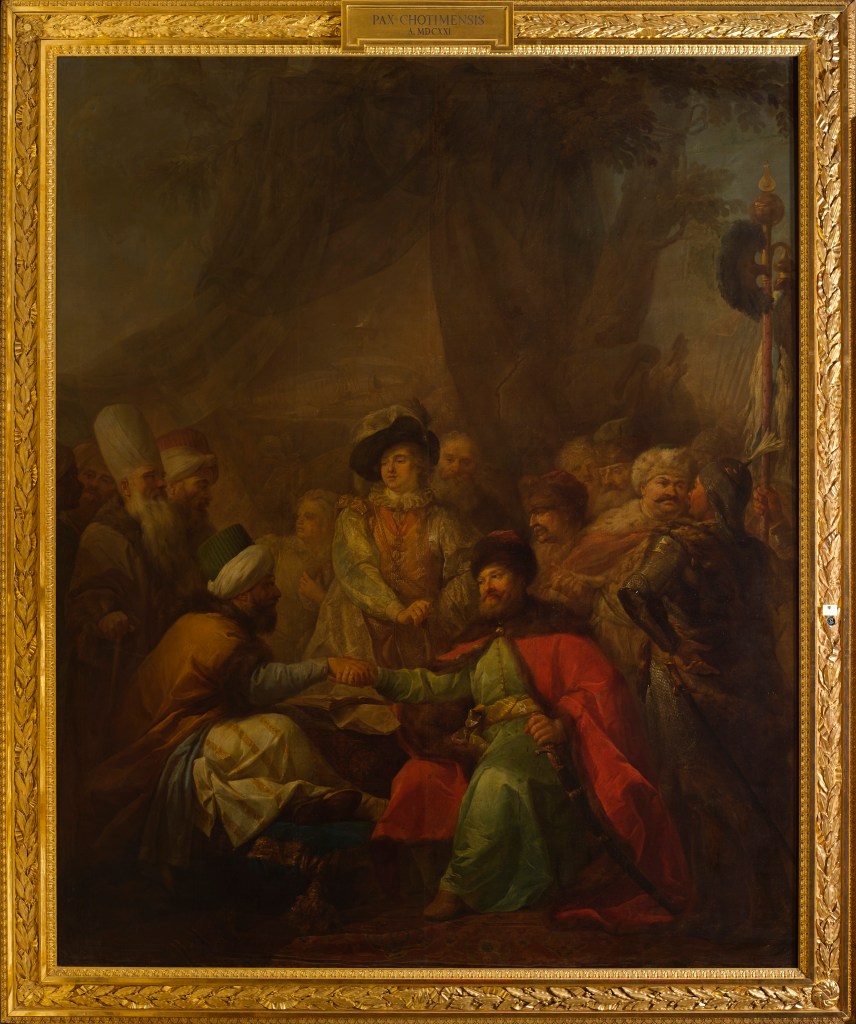
Image: Zamek Królewski w Warszawie – Muzeum, ZKW/3413, Marcello Bacciarelli, Pokój chocimski, 1782-1783.
One of my favourite artworks that deals with the theme of peace is an unassuming and easily overlooked painting that hangs in the corner of the Knight’s Hall in the Royal Castle in Warsaw. Pokój Chocimski (“Peace of Chocim”) was created in 1782-1783 by Marcello Bacciarelli, a Roman-born court artist of the last king of Poland-Lithuania, Stanislaus II Augustus. It depicts a treaty concluded between the Polish-Lithuanian Commonwealth and the Ottoman Empire on 9 October 1621. The agreement ended a war that broke out a year before and culminated in an inconclusive Ottoman siege of the border fortress of Chocim/Hotin in the contested Principality of Moldavia (now Khotyn in southwest Ukraine).
The reason why I find this oil painting remarkable is the fact that its central motive is a gesture of peace. The treaty of Chocim is symbolically represented by a solemn handshake between the Ottoman grand vizier (prime minister) Dilaver Pasha and Stanisław Lubomirski, the commander of the Polish-Lithuanian army at Chocim. While there are literally thousands of artworks portraying battles and other scenes of war, only few depict peace treaties that end those wars. Am I the only one who thinks that it should be the other way round?
Unfortunately, many people in the West still reduce Christian-Muslim relations in the medieval and early modern periods to interreligious wars and overestimate the significance of armed clashes, such as the battle of Poitiers in 732, the naval battle of Lepanto in 1571 or the second siege of Vienna in 1683, where Christian victories supposedly prevented an imminent Islamisation of Europe.
This is particularly true in predominantly Catholic Poland where the memory of military victories against the Ottomans in the 17th century has shaped the persistent myth of Poland as the “Bulwark of Christendom”. In fact, Poland-Lithuania was one of the first Christian countries (after France) to establish friendly relations with the Ottoman Empire in 1533 and later coexisted peacefully with the Muslim power for almost a hundred years. As you can see in Bacciarelli’s painting, Polish nobles (on the right) adopted many elements of Turkic dress in their own attire and thus the Polish general is hardly distinguishable from his Ottoman counterpart.
After a period of wars in the 17th century, the two countries eventually became allies against Russia and, when the Polish-Lithuanian Commonwealth disappeared from the map of Europe at the end of the 18th century, the Ottoman Empire was the only great power not to recognize the partitions of Poland by Russia, Prussia and Austria. Interestingly, in 2018, Bacciarelli’s Peace of Chocim was temporarily removed from display at the Royal Castle in Warsaw and underwent complex restoration works that were generously financed by the government of the Republic of Turkey (the successor state of the Ottoman Empire). This gift was officially meant to mark the 100th anniversary of Poland regaining independence in 1918 but I think it also shows that modern Türkiye has recognised the value of a shared history of peace between the two countries.
In contrast, although debunked by Polish historians a long time ago, the myth of the “Bulwark of Christendom” still holds its sway among many contemporary Poles and, at least in my opinion, contributed to their generally hostile attitude towards Muslim migrants who arrived in Europe during the so-called refugee crisis of 2015. In this context it is worth noting that Bacciarelli’s masterpiece, painted at the heyday of Polish Enlightenment, depicts former enemies, a Catholic commander and a Muslim statesman, shaking hands as equals. This celebration of peace was inspired by a historical scene that took place in a remote Moldavian fortress at a time when the unrelenting “wars of religion” ravaged across much of Western and Central Europe.
Four hundred years later, the town of Khotyn belongs to Ukraine which suffers from an equally senseless and barbaric war that was unleashed by Vladimir Putin’s Russia. Can you imagine a few years from now a Ukrainian general shaking hands with a Russian prime minister?
 History of Peace